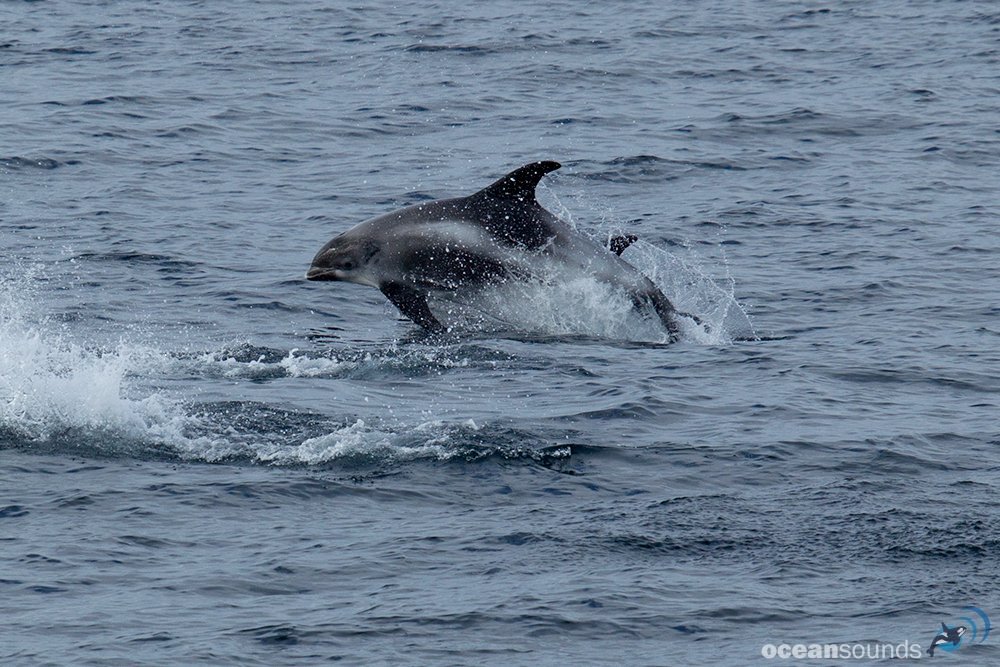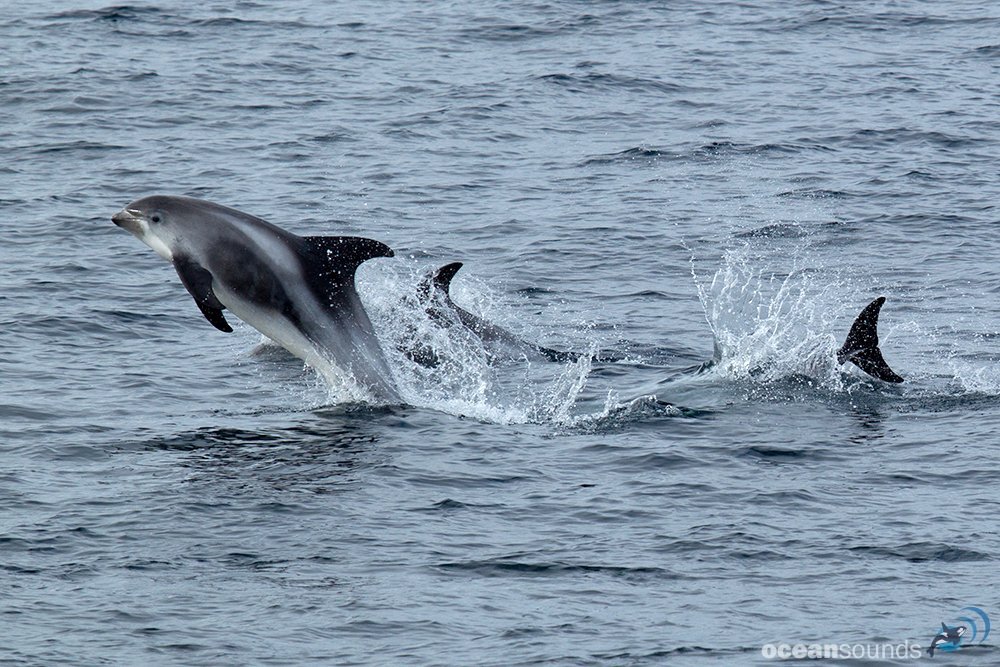
Atlantic white beaked dolphin
(Norsk: Kvitnos)
Lagenorhynchus albirostris
Population (North East Atlantic) : Up to 100,000
Conservation Status : Least Concern
Seen, offshore along the Norwegian coast and Barents Sea. Does not overlap with Atlantic white sided dolphins, and is not often seen inside the Vestfjord – we have seen it only once in 10 years!
Identification: Has a white beak, shaded colors of dark grey and white/light grey on the body.
Group formation: Social groups/fission fusion (size 5-30)
Size: males 3.1 m, females 2.4 m, calf 1.3m
Weight: 180-275 kg, calf 40 kg
Age: up to 39 years
Gestation: 11-12 months
Sexual maturity: 8-10 yrs
Diet: fish, such as herring, mackerel, cod, haddock, capelin, whiting, hake, and sometimes squid, octopus and benthic crustaceans
Distribution: Endemic to North Atlantic Ocean, cold temperate to subpolar waters from northern coast of France in the east, north to southern Greenland, Iceland, and Svalbard.
Population: Up to 100 000 in the North East Atlantic (including the Barents Sea, the eastern part of the Norwegian Sea and the North Sea). Combining estimates, the total population lie around 559,000 individuals.
Conservation Status: Least Concern ver 3.1, Pop. trend: unknown
Whaling (Faroe Islands, eastern Canada, Greenland), plastic pollution, chemical pollution, very sensitive to man-made noise impacts (seismic surveys, military sonar), entanglement in fishing gear, gillnets, cod traps, trawling, overfishing.
Unfortunately we don’t have any videos of this species, we’ve on seen it once in 10 years!
Echolocation clicks: White-beaked dolphins produce echolocation clicks, including “pulse-bursts”, echolocation clicks are transient signals, often between 20–140 kHz. Primarily used for navigation, orientation, and detecting prey
Whistles (Tonal Sounds): These are continuous narrow-band, frequency-modulated signals. While specific frequency ranges for white-beaked dolphin whistles are not explicitly detailed in all sources, general delphinid whistles can range from 800 Hz to 28.5 kHz and last from 100 milliseconds to over 4 seconds. Playback experiments with white-beaked dolphins have utilised amplitude-modulated tones at frequencies of 100, 200, or 250 kHz, indicating their sensitivity to and potential production of sounds in these higher ranges.
Burst-Pulsed Sounds: These are short, high-repetition-rate pulsed transient signals, which can include sounds like squawks, screams, and brays. White-beaked dolphins respond to these “pulse-bursts” in experimental settings
Whistles and burst-pulsed sounds serve as primary social communication signals, playing a role in maintaining group cohesion and individual recognition. Studying dolphin vocalizations in their natural habitat is challenging due to the underwater environment and the internal nature of their sound production, which makes it difficult to visually identify the sound source