
Lacking cetacean welfare during the Faroe Islands’ drive hunt
– Highlighting the importance of the article by Simmons et al.
Yesterday (5/11/2025) the article “An assessment of cetacean welfare in the Faroe Islands’ drive hunt” by Simmons et al. was published in Biology Letters where they highlight the urgent need to reassess the welfare implications of the drive hunt which, in the Faroe Islands, targets mainly pilot whales (Globicephala melas). The importance of this can’t be underlined enough.
Cetaceans are highly intelligent, social, and sentient animals — capable of complex emotions, communication, and suffering. Yet, the conditions under which they are hunted often fail to meet even the most basic welfare standards recognised for terrestrial livestock. The drive hunt, which involves chasing and herding entire groups of whales into bays, breaks up social groups and forces them to strand—collapsing under their own weight—before slaughter. This, along with the handling on shore, causes extreme stress, fear, and prolonged suffering — conditions that would be deemed unacceptable for animals raised for human consumption such as cows, sheep, or pigs.
Several points discussed in this article suggests that these animals are likely to suffer a lot more than previously thought, and the NAMMCO instruction manual on pilot whaling is not enough to ensure humane killings. One example being that the vital adaptation of their brain to function under low oxygen partial pressure while diving may imply that they remain conscious when blood supply to the brain is interrupted. Evidence is also lacking regarding the spinal lance consistency and effectiveness on cutting off the brainstem and blood flow to the brain.
In modern society, welfare consideration for farmed animals are regulated, monitored, and continually improved to reduce suffering. The same ethical thinking must be applied to wild animals, particularly cetaceans, whose advanced cognition and social bonds make the trauma of drive hunts all the more severe. Tradition and culture can hold deep value, but they cannot serve as justification for practices that inflict mass suffering and death.
As our understanding of animal sentience continues to grow, it becomes increasingly clear that compassion and science, not tradition, must guide our treatment of all species.
We encourage you to read the full article for further information and share this important work.
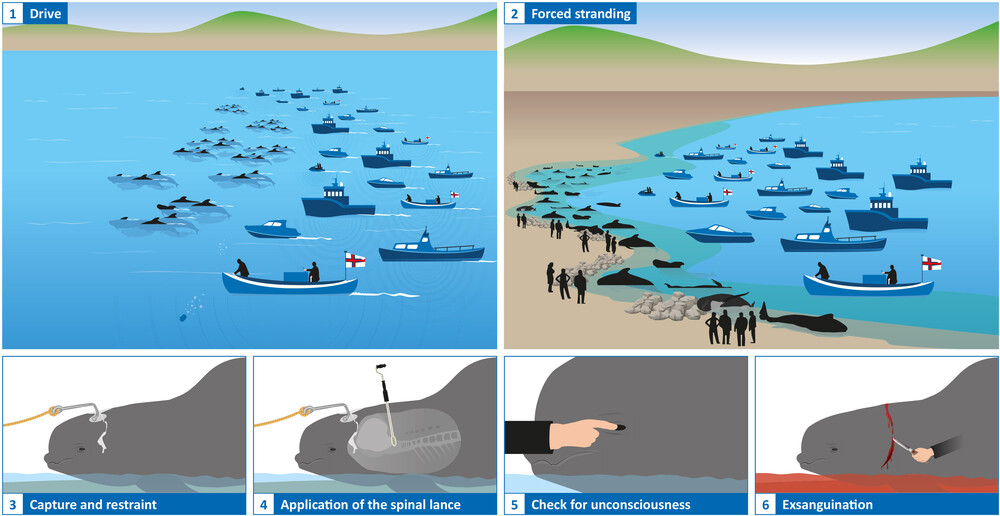
Image, designed by the authors of the article, describing the six stages of the drive hunt – grindadráp